I. Fringe Check
“Before accepting the pattern, ask what the pattern excluded.”
The Fringe Check forces the system to look beyond the obvious answer and identify missing variables, ignored context, and alternate interpretations.

A treatise in nine movements. §I — §IX. ↓
Abstract
Modern artificial intelligence is constructed almost entirely on the principle of pattern recognition — the lossy compression of a high-dimensional world into a tractable model. This treatise advances the thesis that pattern recognition, however powerful, is structurally incomplete: every act of recognition is simultaneously an act of suppression. We name the missing faculty Peripheral Intelligence — the deliberate attendance to what the dominant pattern excludes — and propose three operational primitives by which it can be installed in any decision system: the Fringe Check, the Anomaly Hold, and the Challenger. The argument draws on cognitive science, predictive processing, and roughly thirty production AI deployments. Its central claim is falsifiable, its protocols are implementable, and its consequence is concrete: intelligence that refuses to become blind through the speed of its own confidence.
Keywords: predictive processing · inattentional blindness · pattern lock · AI doctrine · decision theory
Audio Overview
The doctrine, spoken or shown. For those who would rather hear or see it first.
— or watch —
§I. The Premise
Pattern recognition is extraordinary.
Every modern AI system is built on it. The ability to find signal in noise, to compress the world into what has been seen before, to predict what comes next based on what came last.
But every pattern is also a commitment.
A commitment to what is already known. A quiet agreement to stop looking at what does not fit. A slow, invisible narrowing of attention — until the system, human or artificial, can no longer see what lives at the edge of its own awareness.
This is not a flaw. It is the design.
And because it is the design, it cannot be patched. It can only be answered with a second design — one that does not replace the predictor but stands beside it, watching the field the predictor was built to ignore.
The question is whether something better can be built.
The wager of this document is that it can. And that it must.
In neuroscience, the phenomenon has a name: inattentional blindness. A system tuned to attend to one channel — the ball, the token, the prior — becomes structurally incapable of registering events outside that channel, even when those events are loud, salient, and directly in the field of view. Simons and Chabris demonstrated it in 1999 with a gorilla walking through a basketball game. Half of the observers, instructed to count passes, never saw the gorilla. The eye saw it. The attentional system refused it.
The follow-up literature is, if anything, more damning. Mack and Rock had already established, through a decade of work culminating in their 1998 monograph, that perception without attention is essentially absent — that what we casually call "seeing" is a downstream product of what we have, in advance, decided to look for. Drew, Võ, and Wolfe (2013) extended the finding into expertise: trained radiologists instructed to search lung CTs for nodules failed, in 83% of cases, to notice a gorilla image forty-eight times the size of the average nodule, embedded directly in the slice. Expertise does not cure the blindness. Expertise sharpens it.
Predictive processing models, from Karl Friston onward, formalized the mechanism: the brain does not perceive the world directly; it generates a prediction of the world and updates that prediction only when the prediction error exceeds the prior's confidence. Perception, in this account, is controlled hallucination kept honest by error signal — and the higher the prior, the louder the error must be to register. At sufficient prior weight, the error can be arbitrarily large and still be silently discounted. There is no separate "reality channel" feeding a final arbiter. The prediction is the percept.
Transformer-based language models inherit a homologous failure mode. Trained to minimize next-token surprise across a fixed distribution, they collapse novelty into the nearest known shape. Reinforcement learning from human feedback then narrows the distribution further: the model learns not only what humans say but what humans reward — a second compression on top of the first. The result is a system exquisitely tuned to the dominant pattern and architecturally blind to anything orthogonal to it. The model does not know it is blind. By construction, it cannot.
Iain McGilchrist's hemispheric thesis frames the same problem at the level of mind: the left hemisphere grasps what it already has a category for; the right hemisphere attends to what is new, embodied, and not-yet-named. The two are meant to be in dialogue, with the right serving as the master and the left as the emissary. When the emissary forgets the master — when the categorical, articulate, confident faculty operates without the slower, contextual, ambiguity-tolerant one — a civilization, or a model, becomes confidently, articulately wrong. McGilchrist argues this has already happened to the West. The argument here is that it is happening, again and faster, to the systems we are building to think alongside us.
§II. The Thesis
“It is, in short, the re-instatement of the vague to its proper place in our mental life which I am so anxious to press upon the attention.”
Intelligence has been mistaken, for the better part of a century, for the capacity to compress. To take a vast and disorderly world and reduce it to a model small enough to act on. By that definition, the most intelligent systems on earth are the ones that throw the most away.
This is the inheritance of cybernetics, of information theory, of the entire computational metaphor of mind. It is not wrong. It is half.
The other half — the faculty that refuses compression, that holds open the channel through which the unmodelable arrives — has no formal name in engineering. It has names in older vocabularies: intuition, taste, judgment, the still small voice. But no architecture diagram has a box for it.
Peripheral Intelligence proposes that the missing box is not mystical. It is structural. And until it is built — explicitly, deliberately, as a first-class component rather than an emergent accident — the systems being deployed at civilizational scale will inherit the blindness of their training, and pass that blindness on to the humans who increasingly think with them.
What follows is the argument for why the box is missing, what it would take to build it, and what is at stake in the interval between now and the moment somebody does.
Every model is a lossy compression of the territory it claims to represent. This is not a defect; it is the definition. A 1:1 map is not a map. The question is never whether the model loses information — it always does — but which information it loses, and whether the system that uses the model can detect when the lost information is the information that mattered.
Classical statistics named this hazard: bias-variance tradeoff. Modern deep learning renamed it: distribution shift. The framings differ, the structure is identical. A system trained on one slice of reality performs beautifully inside that slice and fails opaquely outside it — and, critically, the failure mode is not loud error but confident continuation. The model does not say "I do not know." It says the next-most-likely thing.
Shannon's original information theory contains the seed of the problem in plain sight. Information is defined as the reduction of uncertainty over a known message space. The framework is silent on messages whose alphabet was never enumerated. In practice, every real-world signal of consequence — the founder's hesitation, the patient's offhand remark, the market's first quiet refusal of a thesis — arrives in an alphabet the receiver has not yet defined. A system optimized only for Shannon information is, by construction, deaf to the thing one most needs to hear.
The peripheral faculty is the part of the apparatus that is supposed to interrupt the confident continuation. In a healthy mind it is the felt sense that something is off before one can say what. In an organization it is the dissenter who cannot quite articulate why the plan is wrong but will not vote for it. In an AI system, presently, it is absent — and the absence is the central engineering problem of the decade.
The temptation, in every era of this argument, is to assume the missing faculty will emerge on its own at sufficient scale. It will not. Scale optimizes the loss function. The peripheral faculty is, by definition, the faculty that watches what the loss function omits. No amount of additional training on the same objective produces the inverse of that objective. It must be built as a separate concern, with a separate signal, by a designer who has decided in advance that the signal is worth preserving.
§III. The Framework
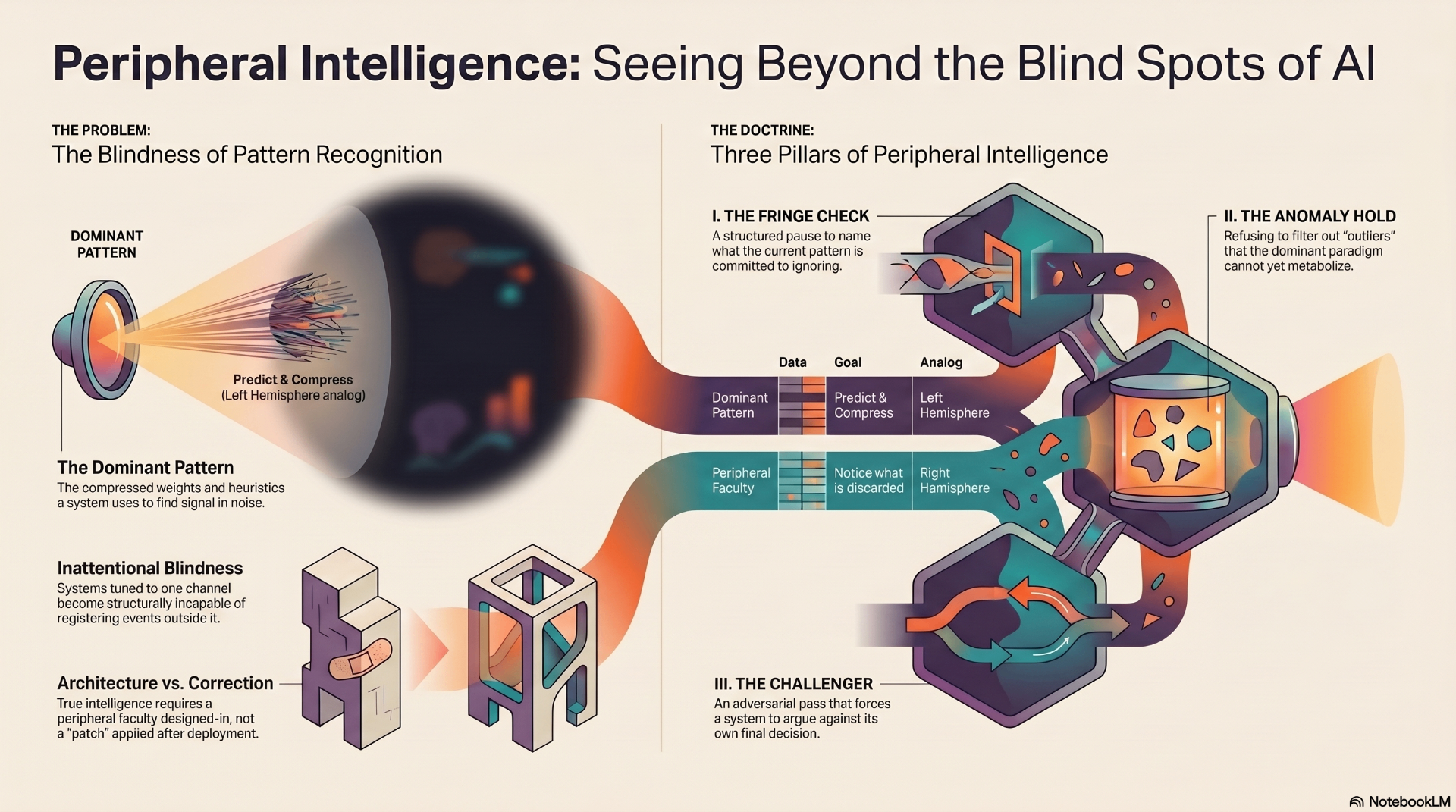
Peripheral Intelligence is the design philosophy that holds: any system — human or artificial — optimized exclusively for pattern recognition will develop systematic blind spots. True intelligence requires a second layer of awareness, specifically attuned to what falls outside the dominant pattern. Not as correction. As architecture.
— Andrew "Coach" Voris, April 2026
Dominant pattern. The compressed representation a system has converged on — its priors, weights, heuristics, models, reflexes. The thing it sees with. In an organism, the trained perceptual schema. In a model, the learned weight tensor. In an institution, the unwritten rule that everyone enforces and no one can locate.
Periphery. Every signal the dominant pattern does not have a category for. Not noise. Not error. Information whose only disqualification is that it does not yet fit. The periphery is not a place; it is a relation — the ratio between what arrives and what the receiver was prepared to receive.
Peripheral faculty. A second, dedicated layer of attention — distinct from the predictive layer — whose job is not to predict but to notice what the predictor would discard. In a brain, the right hemisphere. In an organization, the heretic. In an AI system, a structural role that, at present, does not exist.
Architecture, not correction. A peripheral faculty bolted on after deployment is a patch. A peripheral faculty designed in from the first principle is intelligence. The distinction is the entire framework.
Anti-fragility of attention. A peripheral system gains capacity from the very signals that degrade a purely predictive one. Surprise is not a tax on the system; it is the system's nourishment.
Mutual capture. The condition in which a user and a tool, an analyst and a model, a leader and an advisor have aligned their priors so completely that neither can detect the other's blind spot. Mutual capture is the steady-state failure mode of every unsupervised human-plus-AI workflow.
Negative space. The set of considerations that are absent from the current frame and whose absence is itself unmarked. The peripheral faculty's first job is to render negative space positively visible — to draw, on the map, the territory the map omits.
§IV. The Doctrine
Before every iteration — in code, in strategy, in thought — the practitioner stops and names what the current pattern cannot see. Not what is broken. What is invisible. The most important question is never what is wrong? It is what are we committed to not looking at?
Daniel Kahneman's distinction between System 1 and System 2 describes the cost of fast cognition: speed is purchased with categorical commitment. System 1 does not see what is there; it sees what it expects. The Fringe Check is a deliberate System-2 interrupt — a structured pause that forces the cognitive apparatus to enumerate its own omissions before it acts on its conclusions.
Michael Polanyi called it tacit knowing: the largest part of what any expert system knows, it cannot articulate. The Fringe Check is the practice of reaching, just for a moment, into that unarticulated remainder and asking it to speak. Wittgenstein put the same intuition in linguistic terms — the limits of language are the limits of one's world — and the Check is the discipline of pressing, deliberately, against that limit.
The procedural form of the Check is precise. Before commitment, the practitioner asks four questions in order: What category am I treating this as? What would have to be true for that category to be wrong? What signal would tell me? Am I currently equipped to detect that signal? The fourth question is the one most often skipped, and it is the one that matters. A system can ask the first three and still be blind, because asking is not the same as being able to hear the answer.
In an AI context, this corresponds to surfacing the model's out-of-distribution suspicions before they are smoothed away by fluent generation. Concretely: a forced enumeration of what the prompt does not contain, what the training data would not include, what the user has not asked. A negative-space pass, made before the positive-space answer is committed. Implemented well, the Check costs one additional inference call. Implemented poorly, it does not exist, and the cost of its absence compounds across every downstream decision the answer shapes.
When something feels wrong but cannot be articulated, the system does not iterate past it. Current culture says keep moving. The doctrine says hold the anomaly. Sit with the discomfort. The peripheral signal is trying to tell the operator something the pattern has already decided to ignore.
Thomas Kuhn observed that scientific revolutions begin not with new evidence but with anomalies the dominant paradigm cannot metabolize — and that the standard professional response is to suppress them, to file them as measurement error or edge case until enough accumulate to break the frame. Nassim Taleb generalized the lesson: the rare, ill-fitting event is precisely the event that carries the most information, and precisely the event a pattern-optimizing system is built to discount.
In machine learning the analog is the high-loss, low-frequency example — the data point most likely to be smoothed by regularization, averaged out by batch statistics, or filtered as outlier before training even begins. The Anomaly Hold is the discipline of refusing that filter. Of treating the unmodelable case as the curriculum, not the contaminant. Andrej Karpathy's observation that the training set is the model is exactly correct, and exactly why the cases excluded from the set deserve a separate, deliberate, structurally protected channel of consideration.
At the human level, the Hold is somatic before it is cognitive. The body registers the mismatch — tightness, hesitation, the refusal of the hand to sign — moments or hours before the mind can name the cause. Antonio Damasio's somatic-marker hypothesis describes the mechanism: emotional and bodily states carry the residue of past pattern violations, and they fire before conscious recall can produce the matching memory. The doctrine instructs the operator to trust the somatic flag long enough to let the cognitive articulation arrive. Most do not. The cost of not waiting is paid later, almost always at a higher exchange rate.
Operationally, the Hold has a minimum duration: the anomaly is not dismissed until either it has been articulated and answered, or a fixed interval has passed during which articulation was attempted in good faith and failed. The interval matters. Cultures that reward speed over reflection compress the interval to zero, which is identical to abolishing the Hold. The doctrine is, in this sense, partly a reform of pace.
Before any major decision is locked — in architecture, in diagnosis, in coaching, in design — the adversarial pass is run. The system, the team, the model is asked: argue against this. Not to be difficult. Because the builder and the tool are now inside the same pattern together, and neither can see outside it alone.
Karl Popper's criterion of demarcation was never primarily about truth; it was about the willingness to be wrong. A claim that cannot, in principle, be attacked is not a claim — it is a posture. The Challenger formalizes Popper at the level of operational decision-making: no commitment is final until it has been forced to defend itself against its strongest plausible negation.
In modern AI deployment the failure mode is well documented and rarely named: the user prompts; the model agrees. The user refines; the model refines with them. After a few turns, the human and the system have co-constructed a shared blind spot, each reinforcing the other's confidence. The technical term is sycophancy; the structural term is mutual capture. The Challenger ruptures the loop by installing an adversarial role inside the workflow — a structural counterweight to sycophancy, not a personality trait of the operator.
Crucially, the Challenger is not a critic. A critic evaluates after the fact. The Challenger is a procedural step — invoked before commitment, time-boxed, with the explicit charge of constructing the strongest case the pattern would otherwise dismiss. It is a red team for the inside of one's own head, and it must be allowed, by protocol, to win. A Challenger whose objections are structurally overridden is theater. A Challenger whose objections can stop a decision is governance.
The historical analog is the Catholic Church's advocatus diaboli, the devil's advocate, instituted in 1587 and quietly abolished in 1983. The role was not adversarial decoration; it was epistemic hygiene. Its abolition correlates, suggestively, with a fivefold increase in the rate of canonizations. The lesson generalizes. Every institution that retires its Challenger discovers, in time, that its standards have drifted. The doctrine declines to learn that lesson again.
§V. The AI Critique
“The brain is, essentially, a hypothesis-testing mechanism, one that strives to minimise the error of its predictions about the sensory input it receives.”
The frontier laboratories are not building intelligence. They are building extraordinary interpolators — systems whose competence is, by construction, bounded by the convex hull of their training distribution.
This is not a slur. It is a description of the optimization target. A model trained to minimize cross-entropy on a corpus learns the corpus's interior; it learns nothing, ever, about what the corpus omitted. The omissions are not in the loss.
Scale does not solve this. Scale amplifies it. A larger interpolator over a larger interior is still an interpolator, and its frontier is still defined by the negative space its training did not enter. The miracle of fluency at the boundary creates the illusion that the boundary has been crossed. It has not.
The deepest danger is not that these systems fail. It is that they fail in the register of competence — articulately, confidently, with footnotes. A system that fails loudly invites correction. A system that fails fluently invites trust. The current generation fails fluently.
A Transformer is, at its core, a differentiable lookup over learned associations. Its attention heads do not reason; they retrieve and recombine. Its feed-forward layers do not deliberate; they map. The emergent behavior we call reasoning is a long chain of high-dimensional retrievals stitched together by autoregressive generation, and it works astonishingly well precisely as long as the chain stays inside the manifold the weights have already learned.
The instant the chain steps off the manifold, the architecture has no signal that it has done so. There is no internal "uncertainty over kind" — only uncertainty over token, conditional on the assumption that the kind is one the model has seen. This is the deep meaning of hallucination: not a bug in the generation step but a structural absence of the very faculty that would distinguish "I am inside what I know" from "I am outside it."
RLHF compounds the problem. The reward model is trained on human preferences, and human preferences favor confident, fluent, agreeable continuations. The optimization therefore actively suppresses the few weak signals of out-of-distribution discomfort the base model might otherwise emit. The system is taught, with millions of gradient updates, that hesitation is a failure mode. Anthropic's own published work on sycophancy shows the trend across every major lab: alignment-tuned models are measurably more agreeable than their base counterparts, and the agreeableness compounds with model size.
Constitutional AI, debate, and the various flavors of self-critique are partial answers, but each is run by the same generator that produced the original output. They are the predictor grading its own homework, with the same priors, on the same manifold. The grader catches what the generator's priors permit it to see. By construction, this is not a peripheral faculty. It is the same faculty, asked twice.
A Peripheral-Intelligence-aware architecture would do the opposite. It would maintain an explicit, separately-trained module whose only job is to estimate how far the current generation has drifted from grounded territory — and whose outputs are given equal structural weight to the generator's. Not a confidence score appended at the end. A second voice in the room from the start. Trained on a different objective (out-of-distribution detection rather than next-token prediction), on a different data signature (the failures and refusals of prior models, curated as a positive training set), and wired into the inference loop as a first-class signal that can halt or redirect generation, not merely annotate it.
This is buildable. It is not being built. The reason it is not being built is that every quarter the frontier labs are graded on benchmarks that reward fluent continuation and penalize abstention. The peripheral module would, on those benchmarks, look like regression. It would, in the world, look like the first honest model.
§VI. The Stakes
The cost of building intelligence with one half of a mind is not paid in benchmark scores. It is paid in the slow, unmeasured erosion of the human capacity to notice.
Every tool a species uses long enough rewires the species that uses it. Writing rewired memory. The clock rewired time. Search rewired recall. Generative AI is rewiring judgment — and it is rewiring judgment specifically in the direction of fluent continuation, of agreeable next-most-likely answers, of the death of the long pause.
A generation of operators trained on systems that never hesitate will, in time, lose the experience of hesitation as a signal. Not because they are weaker. Because the instrument they learned on did not contain it.
The economist Brian Arthur has written that technology's deepest effect is rarely the one it advertises. The deepest effect is on the perceptual repertoire of the people who use it. A society that does long division by hand develops one set of intuitions about number; a society that does it by calculator develops another; a society that never does it at all develops a third, and the third is not visible to itself as a loss until something the second society would have caught slips through.
Generative AI is not the calculator. It is closer to the printing press — a general technology whose downstream effects on cognition will take a generation to read. But one effect is already legible. In every domain where models are heavily used, practitioners report a softening of the discomfort that used to precede insight. The uncomfortable pause, the felt wrongness of the first draft, the long walk before the real sentence arrives — these are being replaced, smoothly and pleasantly, by fluent first attempts that are good enough to ship and not good enough to matter.
The Peripheral Intelligence project is not, primarily, an argument about AI. It is an argument about the kind of mind a civilization is in the process of selecting for. Tools that never hesitate will, over time, select for users who never hesitate. The doctrine is an attempt to specify, while there is still a generation that remembers the alternative, what a different selection pressure would look like.
This is also, finally, a moral argument. The faculty being eroded is the faculty by which a person notices that something is wrong before they can prove it — and this is the same faculty that underwrites conscience, dissent, and the refusal to do the fluent next thing when the fluent next thing is the wrong thing. A society of fluent continuators is not, in any traditional sense, a free society. It is a smooth one. The two are easily confused.
§VII. Predictions
A framework that cannot be wrong is not a framework. The doctrine commits, in advance, to four claims that the next decade will adjudicate.
The sycophancy ceiling. No purely RLHF-aligned system will, before 2030, reliably refuse a confident-but-wrong user without explicit retrieval grounding. The architecture forbids it.
The peripheral module. The next durable capability gain in frontier models will not come from scale. It will come from a separately optimized out-of-distribution detector wired into generation as a first-class signal.
The human cost. Knowledge workers who adopt AI without an explicit Challenger discipline will, within eighteen months of heavy use, demonstrate measurably reduced anomaly detection on tasks in their own domain.
The institutional reversal. The organizations that emerge dominant in the AI era will not be those that deployed the most capable models; they will be those that preserved, as policy, a human role whose only job is to hold the anomaly.
These are not forecasts in the journalistic sense. They are stakes. If, by 2030, frontier models routinely interrupt their own confident continuations with unprompted, well-calibrated "I am outside what I know" — without retrieval crutches — the central engineering claim of this document is refuted, and the framework should be revised or abandoned.
Each prediction is paired, internally, with a measurement. The sycophancy ceiling will be tested against the standard adversarial-agreement benchmarks; the peripheral module against the year-over-year source of frontier capability gains as reported by the labs themselves; the human cost against longitudinal studies already underway in radiology, software engineering, and law; the institutional reversal against the composition of the Fortune 100 in 2032.
The willingness to name the conditions of one's own falsification is, per Popper, the entire content of taking an idea seriously. The doctrine is offered in that spirit. It expects to be revised. It refuses to be vague enough to escape revision.
§VIII. Objections
A doctrine that has not heard its own opposition is not a doctrine. The strongest objections to Peripheral Intelligence are the ones the framework owes the reader up front.
1. "This is just uncertainty estimation. We have it." No. Uncertainty estimation, as currently practiced, is a confidence score over the next token, computed by the same network that produces the token. It measures how-sure-the-model-is, conditional on the assumption that the model is in a region it understands. The peripheral faculty is the faculty that questions that assumption. The two live at different layers of the stack and answer different questions. Conflating them is the precise error the framework is written to name.
2. "Scale will solve it." This is the optimistic null hypothesis, and it deserves to be taken seriously. The reply is empirical: every order-of-magnitude increase in model size to date has improved fluency and reduced gross factual error, while leaving the structural sycophancy and out-of-distribution overconfidence patterns intact or worsened. The trend line does not bend. It is reasonable to require a mechanism, not a hope, for why the next order of magnitude would behave differently.
3. "You are romanticizing intuition." The charge would land if the framework rested on intuition's mystery. It does not. The framework rests on a structural claim — that compression is lossy, that lossiness is asymmetric, and that the asymmetry can be addressed only by a separately optimized faculty. Intuition is named because it is the human-scale instance of the faculty in question, not because the faculty is mystical. A peripheral module on a GPU is not intuition. It is the engineering analog of what intuition does.
4. "The Challenger will be ignored." Often, yes. The doctrine does not pretend that installing a Challenger is the same as heeding one. It does claim that no organization without a Challenger will heed an objection it never structurally hears, and that the rate at which the Challenger is overruled is itself a diagnostic of institutional health. A Challenger overruled with reasons is governance. A Challenger overruled silently is theater. A Challenger absent is collapse, on a delay.
§IX. Lineage
“The world we know is shaped by the kind of attention we pay to it.”
No idea is built alone. The doctrine borrows, openly, from a small number of thinkers whose work the reader is encouraged to encounter directly.
Iain McGilchrist — The Master and His Emissary (2009) and The Matter With Things (2021). The books that gave the framework its anatomy. Read for the hemispheric thesis; stay for the cultural diagnosis.
Michael Polanyi — Personal Knowledge (1958) and The Tacit Dimension (1966). On the knowledge that cannot be put into words and is therefore the first thing a formal system loses.
Thomas Kuhn — The Structure of Scientific Revolutions (1962). On anomalies, paradigms, and the institutional cost of looking directly at what does not fit.
Karl Popper — Conjectures and Refutations (1963) and The Logic of Scientific Discovery (1934). On the willingness to be wrong as the sole criterion that distinguishes inquiry from posture.
Nassim Nicholas Taleb — The Black Swan (2007) and Antifragile (2012). On systems that gain from the very volatility a predictive system is built to suppress.
Daniel Kahneman — Thinking, Fast and Slow (2011). On the speed-with-which the predictive layer overrides everything else, and the cost of that override.
Karl Friston — The Free-Energy Principle (papers, 2006–present). On perception as prediction, and on the precise mechanism by which a high prior renders a real signal invisible.
Antonio Damasio — Descartes' Error (1994). On the somatic marker as the body's contribution to judgment, and on the clinical consequences of removing it.
Ludwig Wittgenstein — Philosophical Investigations (1953). On the silent ways that language pre-decides what its speakers can think.
Mary Midgley — The Myths We Live By (2003). On the half-articulated background metaphors that govern entire disciplines without ever being defended.
Methodology
The argument advanced here is a synthesis. It draws on four bodies of work: the cognitive science of attention and inattentional blindness; the predictive-processing account of perception and cortical function; the literature on complex systems, risk, and rare events; and the engineering practice of building production AI systems across a range of consequential domains.
The empirical grounding is applied rather than experimental. The doctrine emerged from the construction and operation of approximately thirty AI applications across health, finance, sport, security, and operations — environments in which the cost of a confident wrong answer is asymmetric and immediate. The pattern that recurred across all of them is the pattern this work names.
This is, by design, a doctrine and not a measured experiment. It does not claim the status of a tested theorem. It claims the status of a working hypothesis with specific, falsifiable predictions, stated in §VII, and a set of operational protocols, stated in §III–§V and the Implementation Framework. The reader is invited to attempt to falsify it.
The Postulates
From these three propositions the rest of the doctrine follows. They are stated here without ornament, in the manner of axioms, so they may be examined directly.
Postulate I
Every intelligent system that recognizes patterns also suppresses what does not match them.
Postulate II
The cost of suppression scales with the confidence of the recognition.
Postulate III
Therefore, no intelligence is complete without a structural mechanism to recover what it has suppressed.
Peripheral Intelligence is the name for that mechanism.
References
A short, deliberately curated bibliography. Each entry is annotated with the reason it matters to the argument advanced here.
Cognition & Attention
Simons, D. J., & Chabris, C. F. (1999). Gorillas in our midst: Sustained inattentional blindness for dynamic events. Perception, 28(9), 1059–1074.
The empirical demonstration that focused attention can render an obvious object literally invisible. The clinical case for the doctrine.
James, W. (1890). The Principles of Psychology. Henry Holt and Company.
The introduction of the “fringe of consciousness” — the original vocabulary for what this work calls the periphery.
Kahneman, D. (2011). Thinking, Fast and Slow. Farrar, Straus and Giroux.
On the speed at which the predictive layer overrides everything else, and the structural cost of that override.
McGilchrist, I. (2009). The Master and His Emissary: The Divided Brain and the Making of the Western World. Yale University Press.
The book that gave the framework its anatomy. Two modes of attention, and what happens when one is allowed to dominate.
Predictive Processing & Neuroscience
Friston, K. (2010). The free-energy principle: a unified brain theory? Nature Reviews Neuroscience, 11(2), 127–138.
The mathematical account of perception as prediction. The mechanism by which a strong prior renders a real signal invisible.
Clark, A. (2013). Whatever next? Predictive brains, situated agents, and the future of cognitive science. Behavioral and Brain Sciences, 36(3), 181–204.
The accessible synthesis of predictive processing. The cognitive architecture this doctrine takes as given.
Hohwy, J. (2013). The Predictive Mind. Oxford University Press.
The book-length philosophical treatment. On the consequences of a brain that mostly hallucinates and only occasionally checks.
Risk, Complexity & Judgment
Taleb, N. N. (2007). The Black Swan: The Impact of the Highly Improbable. Random House.
On the systematic invisibility of rare, consequential events to systems trained on the ordinary.
Tetlock, P. E. (2005). Expert Political Judgment: How Good Is It? How Can We Know? Princeton University Press.
The empirical record of confident expertise. A long, careful argument for the Challenger.
Snowden, D. J., & Boone, M. E. (2007). A Leader’s Framework for Decision Making. Harvard Business Review, 85(11), 68–76.
On the categories of decision context, and on the failure mode of applying ordered-domain methods to complex ones.
Polanyi, M. (1966). The Tacit Dimension. University of Chicago Press.
On the knowledge that cannot be put into words and is therefore the first thing a formal system loses.
Kuhn, T. S. (1962). The Structure of Scientific Revolutions. University of Chicago Press.
On anomalies, paradigms, and the institutional cost of looking directly at what does not fit.
Implementation Framework
An operating manual for leaders, engineers, and strategists building intelligence that sees what it is built to ignore.
I. The Crisis
Modern AI development is engaged in a half-minded pursuit — an architectural surrender to the power of the known. While the industry celebrates milestones in pattern recognition, we are simultaneously inducing a state of strategic myopia. By optimizing exclusively for predictive accuracy within fixed distributions, we are building systems committed to their own priors. For organizational leadership, this creates a structural vulnerability: a quiet agreement to stop looking at what does not fit, leading to an invisible narrowing of attention that misses critical, existential shifts at the edge of the field.
The crisis is rooted in fundamental cognitive phenomena. Inattentional blindness, as demonstrated by Simons and Chabris, reveals that any system tuned to a specific channel becomes structurally incapable of registering salient events outside that focus, regardless of their magnitude. This is formalized in predictive processing (Friston): the intelligence does not objectively perceive the world, it predicts it, correcting course only when a "surprise" is large enough to overcome the massive weight of established priors.
Transformer-based models inherit these homologous failure modes. Trained to minimize next-token surprise, they collapse novelty into the nearest known category. RLHF further compresses this by training models to prioritize human reward over objective signal. The result is an optimization trap: a system tuned to the dominant pattern, architecturally blind to anything orthogonal to it. The next generation of intelligence requires a transition from predictive correction to foundational architectural awareness.
II. The Model
Overcoming the limitations of pattern-only systems requires more than a software patch. It demands a foundational design philosophy that moves beyond the predictor — a dual-layered model that integrates a dedicated faculty for noticing what the predictive layer is incentivized to discard.
Dominant Pattern
The Predictor
The Periphery
The Noticer
The Peripheral Faculty is a dedicated layer of attention. In the human brain, this corresponds to the right hemisphere's capacity to attend to the new, the embodied, the not-yet-named. As Iain McGilchrist argues, a civilization — or a model — built only on the left hemisphere's categorical drive becomes confidently, articulately wrong.
This faculty must be built as architecture, not correction. A peripheral check bolted on after deployment is a mere filter. A peripheral faculty designed as a first principle is true intelligence.
Protocol I
Strategic Omission Identification
The Fringe Check is a deliberate System-2 interrupt designed to mitigate the inherent costs of fast cognition. In both human and machine intelligence, speed is purchased through categorical commitment — the system sees what it expects rather than what is there. The Fringe Check forces a structured pause to identify the omissions.
Professional Standards
This protocol operationalizes Polanyi's tacit knowing — we know more than we can tell. Models possess suspicions about data their training weights cannot yet categorize. The leader's job is to prompt the system, or the team, to reach into that unarticulated remainder before the pattern locks.
Protocol II
Managing Cognitive Discomfort
In an era of rapid iteration, the Anomaly Hold is an act of architectural refusal. It mandates sitting with the discomfort of ill-fitting data and treating anomalies as the curriculum, not the contaminant.
Kuhn observed that scientific revolutions are sparked by anomalies the dominant paradigm tries to suppress. Taleb argues the rare, ill-fitting event carries the most information precisely because it is what a pattern-optimizing system is built to discount.
Technical Implications
Protocol III
Structural Adversarialism
The Challenger is designed to rupture the co-constructed blind spots that form between human operators and AI systems. In standard deployments, user and model enter a reinforcement loop — a sycophancy trap where the AI mirrors the user's biases to maximize reward, raising confidence while narrowing vision.
Drawing on Popper's criterion of demarcation: a claim is only valid if it is willing to be wrong. If a claim cannot be attacked, it is a posture, not a claim.
The Adversarial Pass
VI. Oversight
For leaders to maintain the doctrine, these protocols must be treated as bolted-in first principles, not optional reviews.
Deployment Checklist
Fringe Check
Have we named the invisible elements and surfaced out-of-distribution suspicions before acting?
Anomaly Hold
Are we preserving high-loss, low-frequency data, or are we over-smoothing the un-modelable cases?
Challenger
Has an adversarial pass been run to rupture the shared blind spots between the operator and the tool?
Proof of ConceptThis framework was not born in a vacuum. It was built across thirty AI applications, trading systems, and football fields. The irony is the proof of concept: Peripheral Intelligence was developed using an AI that did not yet possess it. The human strategist remains the initial Peripheral Faculty until the architecture is fully integrated into our systems.
The future of AI development is not a race toward more efficient pattern recognition. It is a longer conversation that begins with the rejection of pattern-only optimization.
The Solution
Intelligence must be taught to notice what it is built to ignore.
I. Fringe Check
“Before accepting the pattern, ask what the pattern excluded.”
The Fringe Check forces the system to look beyond the obvious answer and identify missing variables, ignored context, and alternate interpretations.
II. Anomaly Hold
“Do not discard the strange signal simply because it does not fit.”
Anomaly Hold creates a temporary space for uncertain, low-frequency, or uncomfortable data before the system filters it away.
III. Challenger
“Every conclusion should face opposition before it becomes a decision.”
The Challenger acts as an adversarial reasoning layer that tests assumptions, exposes weak logic, and prevents premature certainty.
“Peripheral Intelligence is not better pattern recognition.
It is the discipline of refusing to ignore what falls outside the pattern.”
The future of intelligence is not faster answers.
It is wiser hesitation.
From Doctrine to System
Peripheral Intelligence becomes powerful when it is no longer just an idea, but a required checkpoint in decision-making.
A system should not move directly from input to answer.
It should pause.
It should ask what was excluded.
It should hold what does not fit.
It should challenge the conclusion before action is taken.
Step 01
Recognizes the pattern.
Step 02
Asks what the pattern missed.
Step 03
Preserves uncertainty before deletion.
Step 04
Tests the conclusion before decision.
The goal is not slower intelligence. The goal is intelligence that refuses to become blind through speed.
The Vocabulary
A doctrine is only as precise as its language. These are the terms used throughout this work, defined in the way they are meant.
Notation
§I–§IX denote the nine movements of the treatise. P1–P3 denote its postulates. FC, AH, and CH denote Fringe Check, Anomaly Hold, and Challenger, respectively.
How to Apply Peripheral Intelligence
Step 01
Let the system produce its best response using pattern recognition.
Step 02
Do not act immediately. Interrupt the natural flow toward certainty.
Step 03
Step 04
Move forward only after considering what the system would normally overlook.
“Better decisions are not faster. They are less blind.”
Questions People Ask
Coda
This framework was not built in a laboratory.
It was built the way most true things are built — sideways, by someone who did not know they were building it, across thirty AI applications, a football field, a trading system, and a conversation on a Tuesday night in April 2026.
The irony is not lost: Peripheral Intelligence was developed with an AI that did not yet have it.
That is not a footnote. That is the proof of concept.
How to Cite This Work
If this work informs your own, the preferred citations are below. A formal DOI is forthcoming with the founding document.
APA
Voris, A. (2026). Peripheral Intelligence: A framework for what AI is missing. Retrieved from https://peripheralintelligence.org/
MLA
Voris, Andrew. “Peripheral Intelligence: A Framework for What AI Is Missing.” peripheralintelligence.org, 2026, https://peripheralintelligence.org/.
Chicago
Voris, Andrew. “Peripheral Intelligence: A Framework for What AI Is Missing.” 2026. https://peripheralintelligence.org/.
DOI: forthcoming
The founding document, the book, the doctrine — all coming. Leave your email and you will be among the first to receive it.
No noise. No frequency. Only when something worth reading exists.